
Key takeaways
- Keep lifting through the month. Reduce the amount of work, not the effort on your main lifts.
- Pick one training slot that fits your day and stick with it: before iftar, after iftar or around suhoor.
- Build suhoor and iftar around protein, slow carbohydrates and fluids, with a third eating occasion later in the evening if you can.
- Drink steadily between iftar and suhoor instead of trying to catch up in one go.
- Sleep is usually the first thing to slip. Protect it with a fixed routine and a short nap where possible.
Training during Ramadan works well for most healthy adults if you make three changes: do a little less in each session, time your workouts around iftar or suhoor, and fit your protein and fluids into the hours between sunset and dawn. The goal for the month is to hold on to your strength and muscle, not to chase personal bests.
This guide covers training, food, hydration and sleep for the month. It is practical advice only, not religious guidance. If you have a health condition such as diabetes, take regular medication, or are pregnant or breastfeeding, speak to your doctor about fasting and exercise before Ramadan begins.
Can you keep training during Ramadan?
Yes. For most healthy adults, training during Ramadan is safe and worthwhile, as long as the plan is adjusted to match the fast. Stopping completely for a month is the more costly choice. Four weeks without any resistance training, combined with less protein and less sleep, is how people lose muscle and then spend the following weeks rebuilding it.
What changes is the dose. You are training with less food and fluid in your system for part of the day, and often on less sleep, so the plan has to respect that. Expect strength to hold steady or dip slightly, and to return quickly once normal eating resumes.
What should your fitness goal be for the month?
Choose one clear goal before the month starts, because the right approach depends on it.
- Maintain. Keep your weight, strength and habits roughly where they are. This is the best choice for most people, especially if work and family commitments are heavy.
- Lose fat steadily. Ramadan can suit fat loss because the eating window is shorter, but only with a moderate deficit and enough protein. A crash approach on top of fasting leaves you tired, hungry and weaker. If you need a refresher, read how a calorie deficit works.
- Build muscle. Possible, but harder, because eating enough in a short window is difficult. If muscle gain is your priority, treat the month as a maintenance phase and push again afterwards.
How should you adjust your training during Ramadan?
Keep the weight on the bar close to normal and cut back the total amount of work. Heavy, well-performed sets tell your body to keep its muscle. Long, exhausting sessions just add fatigue you cannot easily recover from.
A simple way to adjust:
- Train three or four days a week. Full-body or upper and lower sessions work well.
- Keep the main lifts. Squat or leg press, a hinge such as a Romanian deadlift, a press, a row and a pull-down or pull-up cover most of what you need.
- Drop the number of sets by about a third. If you normally do four sets, do three. If you do three, two hard sets will hold your strength.
- Stop one or two reps short of failure. Save grinding sets for after the month.
- Keep sessions to 40 to 60 minutes. Cut accessory work first.
- Keep cardio gentle. Walking is ideal. Hard intervals while fasted are rarely worth it.
When you train matters as much as how. The three realistic slots are shortly before iftar, one to two hours after iftar, and around suhoor. Each has trade-offs, covered in detail in the guide to the best time to work out in Ramadan.
If you feel dizzy, faint, unusually weak or unwell during a session, stop. A missed session costs nothing. Pushing through warning signs can.
How should you eat between iftar and suhoor?
Aim for two proper meals and, where possible, one smaller protein-rich snack, with protein in each. Your daily targets do not change much during Ramadan. The window to hit them just gets shorter.
Protein matters most. Roughly 1.6 to 2.2 g per kg of body weight a day supports muscle when you train, and splitting that across two or three eating occasions is far easier than cramming it into one plate.
| Eating occasion | Main job | Example |
|---|---|---|
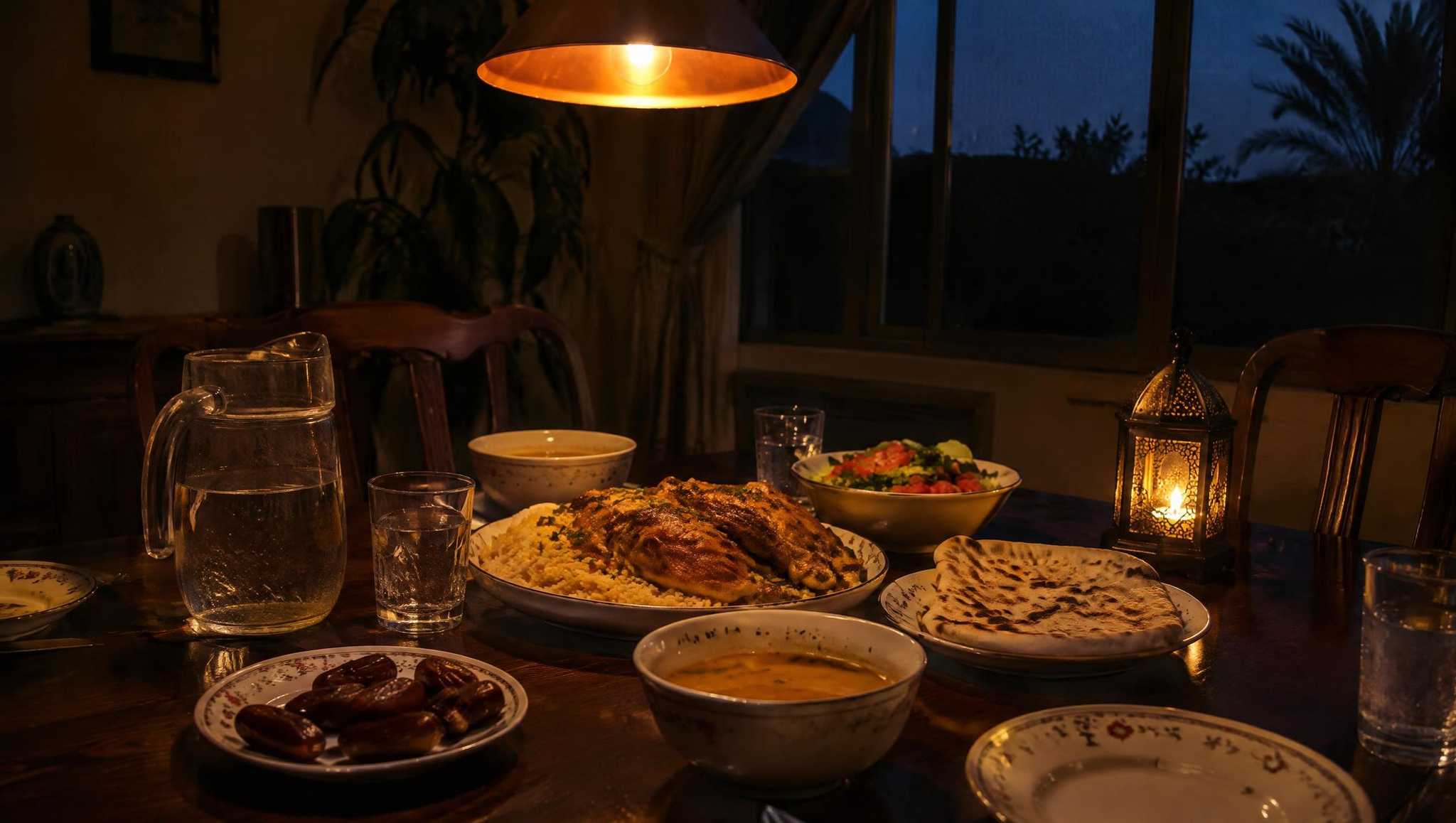
| Iftar | Rehydrate, refuel, first protein serving | Dates and water, lentil soup, then grilled chicken, rice and salad |
| Later evening | Top up protein and fluids | Greek yoghurt or laban with fruit and nuts, or eggs on toast |
| Suhoor | Slow-release energy for the fast | Oats with milk and yoghurt, or eggs, chapati and dal |
Two habits make the biggest difference. First, break the fast gently, then eat a balanced main meal instead of filling up on fried starters. There is a full guide to building a healthy iftar. Second, do not skip the pre-dawn meal. It is your last chance for protein and fluid for many hours, and the guide on what to eat for suhoor gives specific meals.
If you want numbers to work from, the free calorie and protein calculator has a Ramadan mode, and the Ramadan day planner helps you map meals, training and sleep around your own timings.
How do you stay hydrated between iftar and suhoor?
Drink steadily through the evening instead of all at once. Large amounts of water gulped down in one sitting mostly pass straight through, and they leave you too full to eat properly.
A workable pattern:
- One or two glasses of water when you break your fast.
- A glass with your main meal and another within the hour after.
- A bottle within reach through the evening, including during and after training.
- One or two glasses with suhoor.
Soups, laban, milk, fruit and vegetables all count towards fluid. Very salty foods late at night tend to make the next day's thirst worse, so keep pickles, crisps and heavily salted dishes modest at suhoor.
Pale yellow urine by the time you go to bed is a reasonable sign you have caught up. If you train before iftar, pay extra attention to fluids that evening, especially in hot weather.
How do you protect sleep and daily activity?
Fix your sleep routine in the first few days and repeat it. Late evenings and early rising split the night in two, and broken sleep affects hunger, mood and training more than most people expect.
Go to bed at a consistent time after your evening commitments, get back to sleep after suhoor if your schedule allows, and use a 20 to 30 minute nap in the afternoon if you can.
Daily steps usually fall during Ramadan because energy is lower in the afternoon. A relaxed walk after iftar is one of the easiest ways to keep activity up, and it helps digestion after a large meal.
Frequently asked questions
Will you lose muscle during Ramadan?
Not if you keep lifting and eat enough protein. Muscle is lost when training stops and protein drops for weeks at a time. Two or three resistance sessions a week with a few hard sets per exercise, plus protein at iftar, later in the evening and at suhoor, is enough for most people to hold on to their muscle through the month.
Can you lose weight during Ramadan?
Yes, if your total intake across iftar and suhoor leaves you in a moderate calorie deficit. Fasting alone does not guarantee it, because large evening meals, fried foods and sweets can easily replace everything missed during the day. Keep protein high, keep portions sensible and aim for slow, steady loss. Individual results vary.
Should you take creatine during Ramadan?
If you already take creatine monohydrate, you can carry on with 3 to 5 g a day, taken with water at iftar or suhoor. Timing is not important, consistency is. Drink plenty between iftar and suhoor as you normally would. If you have a kidney condition or any medical concern, check with your doctor first.
The bottom line
Ramadan does not have to cost you your progress. Train a little less but keep it heavy, pick a session time you can repeat, get protein into every eating occasion, drink steadily through the evening and guard your sleep. Then pick up where you left off afterwards. Stay consistent.
JR Coaching builds Ramadan-aware plans around your own timings, work and family commitments, with weekly check-ins so the plan is adjusted as the month goes on. You can read more about how online coaching works, or apply for coaching and JR will reply personally.
This guide is general information for healthy adults and is not medical advice. If you have a health condition, are pregnant or take medication, speak to your GP before changing your training or diet. Results vary from person to person.


