
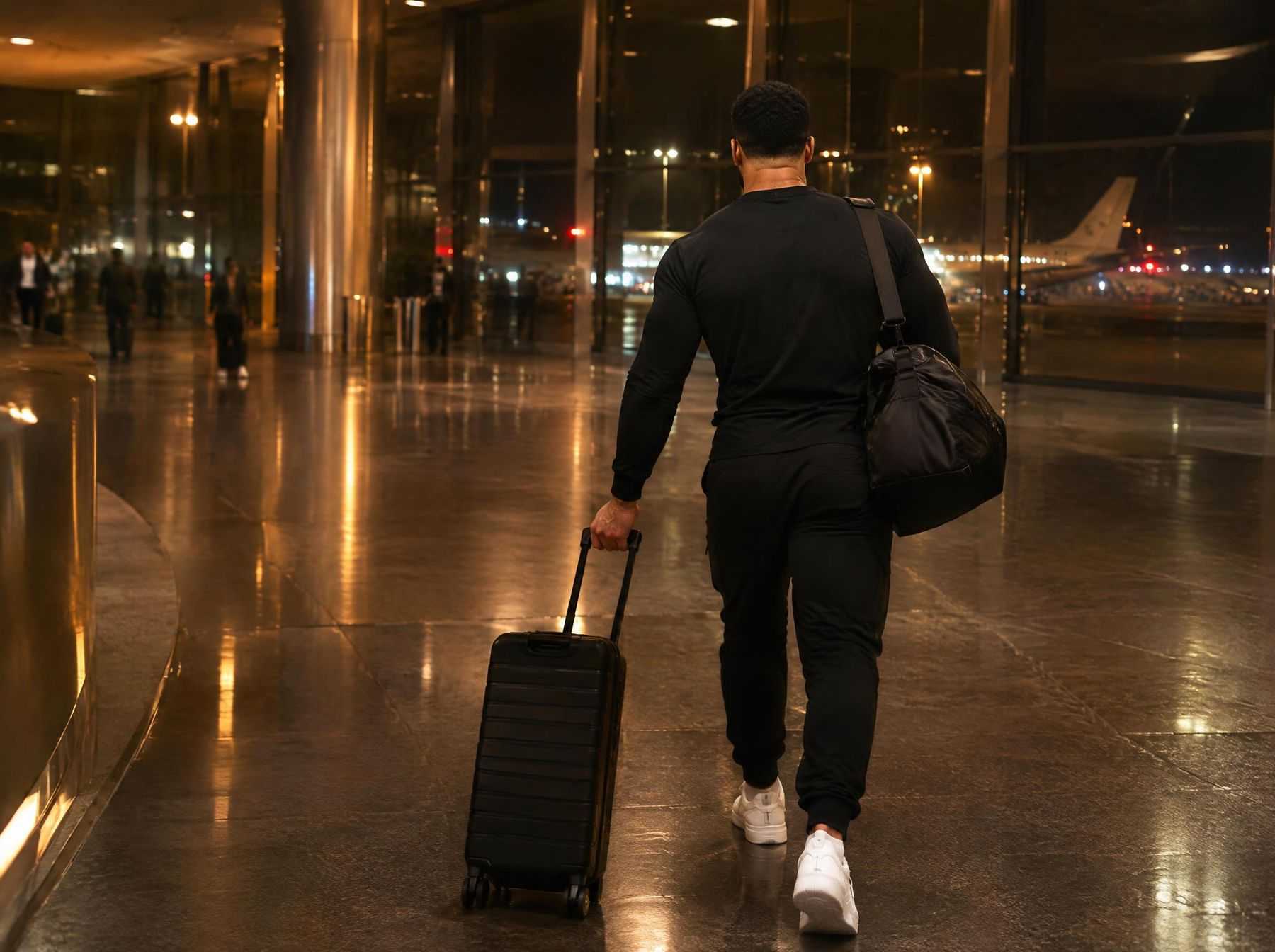
Key takeaways
- Aim to maintain while you are away. Short sessions are enough to hold your strength and fitness.
- Decide your plan before you leave: which days you will train, where, and with what equipment.
- Walking is the easiest habit to keep on any trip.
- Anchor each meal with protein and enjoy the local food in sensible portions.
- Return to your normal routine with the very next scheduled session.
To stay fit while travelling, lower the target from progress to maintenance and keep three things going: two or three short strength sessions a week, a daily step count and enough protein. A hotel gym or a few square metres of floor is all you need. Trips cause problems when the routine stops completely, not when it is scaled down.
Knowing how to stay fit while travelling matters most if you are away often. One week of maintenance costs very little. Stopping completely on every trip costs a lot.
How to stay fit while travelling without a full gym
You can maintain strength and fitness for weeks with far less training than it took to build them, as long as the sessions you do are reasonably challenging. A pair of dumbbells in a hotel gym, or your own bodyweight in the room, is enough for that.
What changes is the aim. At home you are trying to add weight to the bar and move forward. On the road you are trying to hold what you have, keep the habit alive and arrive home ready to carry on.
What workout can you do in a hotel gym or hotel room?
Do a short full-body session built on a squat, a push, a pull and a hinge, using whatever equipment is available. Hotel and compound gyms vary a lot, so it helps to have a version ready for each situation.
| What you have | Session | Time |
|---|---|---|
| Dumbbells and a bench | Goblet squat, dumbbell bench press, one-arm row, Romanian deadlift, overhead press. 3 sets of 8 to 12 each | 35 to 40 minutes |
| Machines only | Leg press, chest press, seated row or lat pull-down, leg curl, shoulder press. 3 sets of 10 to 12 each | 35 to 40 minutes |
| Cardio machines only | 5 minute warm-up, then intervals of harder and easier effort for 15 to 20 minutes, plus press-ups and planks | 30 minutes |
| Nothing (hotel room) | Squats or split squats, press-ups, backpack rows, hip bridges, plank. 3 or 4 rounds | 20 to 25 minutes |
For bodyweight sessions, make the exercises harder instead of simply doing more reps. Slow the lowering phase, pause at the bottom, use one leg at a time or raise your feet for press-ups. A resistance band weighs almost nothing in a suitcase and adds the pulling movements that are otherwise difficult to do without equipment.
How do you keep your steps up on a trip?
Treat walking as your baseline and collect steps wherever the trip allows. Travel days involve long periods of sitting in cars, lounges and aircraft seats, so deliberate walking makes a real difference.
- Walk the terminal while you wait instead of sitting at the gate.
- Explore on foot. Walking is the best way to see most cities.
- Walk for ten to fifteen minutes after meals.
If you already have a daily target, keep it. If you do not, the free daily steps and water calculator gives you a sensible figure, and there is more detail in the guide to how many steps a day you need to lose weight.
Hot climates need a little planning. In the Gulf during summer, walk early in the morning or after sunset, or use indoor spaces such as malls and hotel treadmills. See the advice on training in the heat before exercising outdoors in high temperatures.
What should you eat when travelling?
Build each meal around a protein source, add vegetables or fruit where you can, and enjoy the rest in normal portions. You do not need to track every gram on a trip, and you do not need to avoid the local food. You need a simple rule that works in any airport, hotel or restaurant.
At the airport and on the plane. Options are limited and choices are made when you are tired. Eat a proper meal before you leave if you can. Pack snacks that travel well, such as fruit, nuts in a measured portion, protein bars or a sandwich. In the terminal, look for grilled chicken, eggs, yoghurt, salads with protein or a wrap.
At the hotel breakfast. Buffets are an opportunity, not a trap. Start with eggs, yoghurt or labneh, add fruit and one portion of bread or oats, and leave the pastries for an occasional choice.
At restaurants. Choose grilled meat, fish or chicken dishes, ask for sauces on the side if you want to, and share starters and desserts. In the Middle East, mixed grills, grilled fish, hummus, salads and rice dishes make this easy. The guide to eating out and still losing weight goes into more detail.
Drink water steadily, especially on flights and in hot countries. The article on how much water you should drink a day explains how to adjust for heat and activity.
Should you plan differently for work trips and holidays?
Yes, because the purpose is different. On a work trip your days are structured, so you can usually keep a routine. On a holiday, rest and time with family are the point, and your plan should respect that.
Work trips. Schedule training like a meeting, usually first thing before the day starts. Aim for two or three sessions in a working week away. Decide in advance how you will handle client dinners.
Holidays. Choose a light minimum, such as two short sessions in a week and plenty of walking, swimming and activity you enjoy. Have the meals you came for. A week at maintenance, or even slightly above, will not undo months of work.
Frequent travel. If you are away every few weeks, travel is your normal life and needs a permanent plan, not an exception. That means two versions of your programme, one for home and one for the road, and a clear rule for switching between them.
This is where coaching that plans for travel is useful. JR Coaching is run between the UK and the Middle East, plans work with any gym, a home set-up or hotel gyms, and restaurants and travel are planned for in advance. There is more for clients based in or moving between Gulf countries on the Middle East page.
What should you do when you get home?
Go back to your normal plan at the next scheduled session, without trying to compensate. Do not cut calories hard or add extra cardio to make up for the trip. Your weight may be up for a few days from travel, salt and bigger meals, and most of that is water that settles on its own.
If you trained very little while away, reduce your weights slightly for the first week and build back up. If the trip turned into a longer gap, the guide to getting back on track after a break sets out how to restart sensibly.
Frequently asked questions
How long can you go without training before you lose fitness?
A week or two away from structured training has little lasting effect for most people, and strength in particular holds up well over short breaks. Fitness declines gradually over longer gaps, but it returns faster than it took to build. Even one or two short sessions a week while you are away slows any loss considerably.
Is it fine to take a complete break from exercise on holiday?
Yes. A planned week off can be good for recovery and for your motivation, especially after months of consistent training. Stay generally active with walking and swimming if you enjoy them, and go straight back to your routine when you return. A break only becomes a problem when it drifts on after you are home.
What should you pack to stay fit on a trip?
Pack trainers, one or two sets of training kit, a resistance band and a refillable water bottle. A few portable snacks such as protein bars or nuts help on travel days. That is enough for a full session in a hotel room or gym, and it takes very little space in a carry-on bag.
The bottom line
Travel does not have to break your routine. Plan two or three short sessions, keep walking, put protein first and pick up your normal plan the moment you are home. Forward, every week, even if some weeks are smaller than others. If you travel often and want a plan that moves with you, apply for coaching and JR will reply personally.
This guide is general information for healthy adults and is not medical advice. If you have a health condition, are pregnant or take medication, speak to your GP before changing your training or diet. Results vary from person to person.


